During my fall semester, I had a music in film class and I wrote an essay on what influenced the rise and fall of Hollywood Musical from the 1930s to the 1960s. So here it is:
The Rise and Fall of Hollywood Musicals
According to Barry Grant, film genre critics of Hollywood musicals have tended to focus on The Great Depression’s influence on the rise of the musicals in the 1930s because of the need for lighthearted entertainment as a relief from the hardship of the time (196). However, few have placed Hollywood musicals in a historical context, discussing other influences on their rise development and downfall. As a film genre, early Hollywood musicals were a mix of sentimental, seemingly spontaneous breakouts into song and dance often with conservative ideas about class, gender, sexuality and race. Musicals gave a sense of innocence, fantasy and community, which, by the 1960s, became unpopular. Some of the reasons for the decline included the widening generation gap, the popularity of Rock ‘n’ Roll and the popularity of method actors and realism in film. In this paper, I will examine how changes in technology, culture, the music industry and the Hollywood system had an impact on Hollywood musicals from the 1930s to the 1960s.
From the late 1920s to the early 1930s, the transition from silent film to “talkies” and the Great Depression together contributed to the rise of Hollywood musicals. Decades before, musicals were only available in theatres, such as those on Broadway. However, the first “talkie,” The Jazz Singer, released in 1927, made the idea of the Hollywood musical possible. The first complete example of a musical film came in 1929 with the release of Broadway Melody. Broadway Melody was the first film to have talking and singing throughout it, and the first sound picture and musical film to win an Academy Award (Dirks, 1). Also, the film premiered during the year of the Stock Market crash, which would lead to the Great Depression. Film historians have said that audiences went to see musicals for light-hearted entertainment to forget about hardships of the depression, but the depression had an effect on the production of musical film in other ways. During the Great Depression, musicals and plays in theatres, especially Broadway theatres, struggled because producers did not have enough money to put on shows. Thus, many producers, performers, writers and musicians moved to Hollywood and transposed the staged musicals into filmed musicals. So, it was expected that the first Hollywood musicals would reflect the shows on Broadway. Also, with the transition to sound, studios needed performers and actors who sounded well on film and trained theatre actors and performers needed the work. Audiences were then inundated with Hollywood musicals that followed similar plots of backstage drama, the production of a show and a little bit of romance mixed in. By 1932, musicals began to decline in popularity due to overproduction.
However, the genre saw its revival again in 1933 due to the trademarks of the musical choreographer and director, Busby Berkley. Berkley’s films did follow the same plot style of the backstage musical; however, what separated his musicals from the others was the use of film techniques to his advantage. He was the first to envision that Hollywood musicals were different from staged musicals and much more could be done with a filmed musical. With his trademarks of kaleidoscopic images, over-the-top shots, geometric-patterned choreography, swooping crane shots, trench shots, other daring camera shots and large, extravagant numbers, Berkley made his musicals stand out from the rest. One of his best works was 42nd Street, which was about a Broadway producer who is trying to bounce back after the Stock Market Crash. The main plot centers on the backstage between the showgirls, choreographer and producer, while the subplot is the romances between two couples. “The important thing about 42nd Street (1933) was its realism and the cinematic nature of its musical numbers. It was the quintessential backstage musical but the numbers were filmed from above not straight on like a stageplay” (McLellan).
As the Great Depression reached its peak and the restrictive Hays Code was set in place, Berkley musicals became too expensive and too openly sexual to continue in the same way (Dirks, 2). By 1935, musical film plots needed a change to hold audiences’ attention without large musical numbers, so the plots shifted the focus from backstage life of a staged production to romance. Musical numbers were integrated into the storyline instead of as separate entities within staged shows. In Swing Time, which stars Fred Astaire and Ginger Rogers, the film still centers on entertainers, but stage life is now the background of the plot. Fred Astaire is a dancer whose gambling problems prevent him from getting married. So, he moves to New York where he falls for another dancer, Ginger Rogers. Unlike Berkley films, Swing Time focuses on two leads performing on a small club stage instead of an ensemble cast on a Broadway stage. “The musical and dance numbers are used to further the movie’s plot, not as a spectacle” (O’Brien, 2). Moreover, the film shows the influence of the Hays code in restricting what is done in the film. Throughout the entire film, the men are wearing suits and tuxes while the women wear fancy dresses, and never once does the audience actually see Astaire and Rogers kiss. “When Astaire sings and dances, it's stylized, too: it's Astaire giving a performance, and the audience recognizes that” (Green, 2). Swing Time is formal and genteel in style and some audiences would soon tire of that, too.
By the late 1930s and early 1940s, United States was involved in World War II and coming out of the economic depression, Hollywood musical reflected these changes by producing fantasy, escapism and nostalgia films. The Wizard of Oz is an example of a major turning point in the production of Hollywood films: the Golden Age of Hollywood musicals, MGM as the king of musical film, and the Hollywood musicals’ association with Technicolor. It is one of the first musicals in the late ‘30s to include more social and political context either in the plot and themes. Before musicals would follow the lives of city entertainers or socialites, but The Wizard of Oz is about a small-town girl from Kansas who ends up in the colorful city of Oz. The emphasis on going home is exactly the opposite theme of the rags-to-riches stories of earlier musicals. “The Wizard of Oz was the pivotal event in that Golden Age…because it was the first major musical to take on, however subtly and gracefully, serious psychological themes in the real lives of contemporary people. For all its Technicolor, this is a movie scudding with darkness, about a girl who runs away from home and must find her own way back” (Green, 3). Throughout the ‘40s and into the ‘50s, Hollywood musicals would shy away from the fluff plots of earlier musicals and develop deeper and more complex plots.
Meet Me in St. Louis is another MGM film released during the height of the Golden Era of Hollywood Musical. It follows a family in St. Louis who is getting ready for the world’s fair. As The Wizard of Oz, the plot of the film is based on short stories instead of Broadway shows, and the music numbers are used to further the plot as well as reveal the emotions of the characters. “The resulting film closely corresponded to his ideal of a musical film as a story told in a natural progression from one sequence to another. Songs were closely integrated into the plot” (McLellan). Meet Me in St. Louis takes place in 1903, when music sheets were the most viable way to get music, so the music numbers naturally take place in scenes like the party or when the family is singing in the parlor.
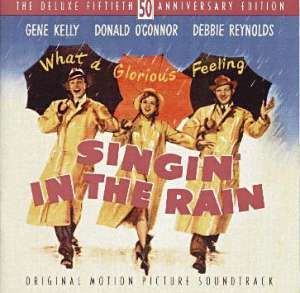
In the early 1950s, the Hollywood musical reached its peak with Singin’ in the Rain. The film is a different take on the backstage musicals of the early ‘30s, and evokes the troubling period of the transition from silent film to “talkies” and the rise of musicals. By then, the traditional Hollywood musical was declining and so the film was a nostalgic musical about the golden age of musicals and pays tribute to the musicals of the past, like Broadway Melody. “With its affectionate parodies of Berkeley's musical numbers, as well as other early musical films, Singin' in the Rain went full circle” (Juddery, 41). Ironically, it is now considered the best musical film of all time, but it was also a sign of decline of the traditional Hollywood because it was Hollywood looking back on its journey. It also is satirical in how it makes fun of the construction and myth of the celebrity persona and Hollywood glitz and glam.
Singin’ in the Rain displays subtly the changing sexual norms that would later be more explicit in Rock ‘n’ Roll. Due to the Hays Code, which was at its peak in the ‘40s, sex scenes or nudity were not allowed in film. So, one of the film genres that could show the intimate side of romance without angering the censors was the Hollywood musical through dance. “…It was in the big budget musicals that sexuality came closest to being explicit. Dancing has always been regarded throughout history as an exceptionally emotional art form. (Sexton, 3). In earlier musical films, the dancing between couples was more reserved because of the Hays code, but musicals still provided a way, even if controlled, to express desire. But in the ‘50s, as the strength of the Hays Code diminished, the dancing was more sexually overt. In the Broadway Melody sequence of Singin’ in the Rain with Gene Kelly and Cyd Charisse, the dancing is obviously very sexual as Charisse, in a short, green flapper dress, shimmies and sways her hips to seduce Gene Kelly’s character. After Kelly releases his pent-up frustration by pulling Charisse to him, they continue with the explicit sexual movements, including swiveling their hips, before Elvis became famous for the same move a few years later.
The mid-50s saw several changes in the society, the music industry, technology and Hollywood, which hastened the decline of Hollywood musicals. After World War II, divisions in society were more noticeable and frictional due to the widening generation gap and the Civil Rights movement. Differences between age groups, racial and ethnic groups, political groups and cultural groups had an effect on target audiences for Hollywood musicals. Also, the type of music that young people were listening to was radically different than the music that the older generations were listening to. The introduction of Rock ‘n’ Roll was a major strike to the musical film. Grant states, “Unlike previous forms of popular music, rock seemed to provide and allow for sexual release rather than sublimation” (198). With Blackboard Jungle (1955) using Rock ‘n’ Roll for the first time in a movie soundtrack, the more conservative Hollywood musical was in troubling waters. Moreover, the youth population bought 80% of the movie tickets in the ‘50s and they were the same group that were buying most of the Rock ‘n’ Roll records (Grant, 199). However, instead of taking advantage of the popularity of Rock ‘n’ Roll music, studios avoided the new music genre because it was socially threatening. “Rock ‘n’ roll…refused to fit neatly into Hollywood’s conventional musical template. They also fragmented the audience, and with family trip to the cinema to see the latest musical spectacular becoming a thing of the past, the studios failed to capture a new generation of fans” (Teachout, 1). This created a split between the rock films that would begin in the late ‘50s and Hollywood musicals, which led to traditional musicals downfall.
Jailhouse Rock, one of Elvis Presley’s first movies, displayed the major influence that Rock ‘n’ Roll and the changing tastes of the public in the mid-to-late ‘50s. Even though MGM produced the film, the major studios did not quickly jump at making rock musicals; Jailhouse Rock was a rarity. For its time, the musical was considered raunchy. Although the musical is reminiscent of the early musical film plot of a relative unknown becoming a star, it opposes most of the Hays code rules. Vince (Presley) has a bad temper, does not respect authority, is sexually and physically aggressive and is charged with manslaughter. Presley uses the word “hell,” tells his costar that she looks “sexy tonight,” and does sexually charged music numbers, “Jailhouse Rock” and “Treat Me Nice.” Also, the setting is not clean either; the film shows the gritty life inside jail, the exploitive music business, inside a strip club and lying in bed with Peggy (Judy Tyler). Moreover, the film shows the generation gap between Peggy’s parents, who listen to Jazz, and Vince, who has no idea what they are talking about.
Another blow to Hollywood musicals was the popularity of television (Juddery, 37). Television became a rival to film in the mid-50s because now families could be entertained at home instead of going to a movie theatre. Although TV companies were not allowed to show films or have film stars on their shows, new variety shows, such as The Ed Sullivan show and American Bandstand, became popular with young people who wanted to hear popular rock songs of the day. Most musicals had used the plot of the film to promote the music and dance numbers, but with these new variety shows, audiences did not need to sit through predictable or over-sentimental stories to listen to the songs.
A final strike was the changes in the Hollywood system and acting. The major Hollywood studios were in the process of dissolving or in decline. So, studios like MGM, which were able to produce big-budgeted musicals in the past, now could not afford it and could not keep certain performers, directors, songwriters and choreographers under contract to their studios. Moreover, the weakening of the Hays Code gave rise to the Method acting workshops of Lee Strasburg and notion of realism in film. Actors such as James Dean, Marlon Brando, Robert Mitchum, and Montgomery Clift were gaining popularity and audiences now wanted to see more of the explicit, grittier side of life. Also, the thought of people “randomly” breaking out into song even in a dramatic scene would become silly and old-fashioned for a more cynical audience. Instead of a man singing and dancing his way to show how much he loved a woman, he could simply kiss her passionately or sleep with her.
In the 1960s, as it was on its last leg, Hollywood musicals either tried to be edgier or more wholesome in terms of plot. West Side Story (1961) was one of the first traditional Hollywood musicals to included racial tension and gender exploration in the plot. In the past, musicals rarely dealt with race; the extent to which they did was either to have the lead characters do blackface or have stereotypical subservient roles for other races. Through the warring of two gangs, the Puerto Rican Sharks and the white Jets, the movie touches on the consequences of racial hatred, especially important during the Civil Rights Era, and rising fear of juvenile delinquency. Also, the film briefly deals with gender in the character of “Anybodys,” who is a tomboy girl who just wants to be one of the boys. The film also brings up other taboo topics, such as in the song “Gee Officer Krupe,” of marijuana, junkies, drunks, social diseases, psychoanalysis, sex (suggestion of it between Tony and Maria) and murder (Bernardo, Riff and Tony die), which is a lot for a musical. However, even with the controversial storyline, as a traditional musical, it sets itself up for ridicule. Watching a street gang snap their fingers and do ballet moves while trying to appear bad and cool does not work. “You see a gang dancing down a real New York street in color-coordinated sneakers, and you just don’t believe it” (Teachout, 2). Moreover, although there is Latin-based music in the soundtrack, the music is still jazz and classically-based; there is no reference to the popularity of Rock ‘n’ Roll amongst teenagers, who are the main characters in the film. The Hollywood musical seemed as if it was going back in time instead of moving forward with the time.
On the other side of the spectrum, Disney, since the release of Snow White, had music and animation go hand in hand. The studio continued with animation and started producing live-action films, too, with a focus on family and children entertainment. In 1965, Disney released Mary Poppins, a silly and cartoonish story about a magical nanny, and officially took the musical king crown from MGM. Since classic musicals lived on fantasy and spectacle, Disney used it to its advantage by targeting children and family audiences, who would be more acceptable of the spectacle, fantasy, and sense of community and innocence found in musical film. Even today, Disney expanded its audience to pre-teens and teens with TV movies like High School Musical.
By the mid-60s, the Hays code was gone and audiences were no longer impressed by the spectacle of Hollywood musicals. “Indeed, as moviegoers became accustomed to grittier, evermore realistic directorial styles…contemporary audiences would not accept a movie whose characters “burst out into song” in otherwise naturalistic context” (Teachout, 2). Sexual liberation movements and the counter-culture had an impact on what could be shown in film. Violence and sex were now in plain view in movies such as Bonnie and Clyde (1967) and The Graduate (1967), and rock movies and concerts were more appealing than the conventional musical film. Musicals were never able to fully solve what Green calls the “Uvula Problem: the general discomfort that audiences feel when a character “spontaneously” break out into a song-and-dance number in a film (4). In a post-modern world filled with cynicism, alienation, identity politics, diversity, etc., the atmosphere that was once conducive to the Golden Age of the traditional Hollywood musical is gone.
Hollywood Musicals Bibliography
42nd Street. Dir. Busby Berkley. Perf. Warner Baxter, Bebe Daniels, George Brent. Warner Brothers, 1933.
Broadway Melody. Dir. Harry Beaumont. Perf. Charles King, Anita Page and Bessie Love. MGM, 1929.
Dirks, Tim. “Musicals-Dance Films.” American Movie Classics: Filmsite. 2010. 30 Sept. 2010. <>
Grant, Barry K. “The Classic Hollywood Musical and the ‘Problem’ of ROCK 'n' ROLL.” Journal of Popular Film & Television 13.4 (1986): 195-205. Academic Search Complete. EBSCOHost. City University, New York City, Newman Lib. 30 Sept. 2010.
Green, Jesse. “How Do You Make a Movie Sing.” New York Times Online. 13 May, 2005. 3 Oct. 2010.
Jailhouse Rock. Dir. Richard Thorpe. Perf. Elvis Presley, Judy Tyler and Mickey Shaughnessy. MGM, 1957.
Juddery, Mark. “Breaking the Sound Barrier.” History Today 60.3, (2010): 36-43. Academic Search Complete. EBSCOHost. City University, New York City, Newman Lib. 30 Sept. 2010. < direct="true&db="a9h&AN="48559324&site="ehost-live">
Mary Poppins. Dir. Robert Stevenson. Perf. Julie Andrews, Dick Van Dyck, and David Tomlinson. Buena Vista Distribution, 1964.
McLellan, Derek. “The Hollywood Musical.” The Golden Age of Hollywood. 2007. 30 Sept. 2010.
Meet Me in St. Louis. Dir. Vincente Minelli. Perf. Judy Garland, Margaret O' Brien, and Mary Astor. MGM, 1945.
O’Brien, Clare. “Song and Dance: The Rise and Fall and Rise of the Movie Musical.” Helium. 2002-2010. 30 Sept. 2010. http://www.helium.com/items/97757-best-musicals-of-all-time
Peyser, Marc. “Gotta Dance.” Newsweek 131.25 22 (June 1998): p106. Academic Search Complete. EBSCOHost. City University, New York City, Newman Lib. 30 Sept. 2010.
Sexton, Timothy. “The Aesthetics of Sex and the Death of the Hollywood Musical.” Associated Content. 24 Jun. 2005. 30 Sept. 2010.
Singing in the Rain. Dir. Stanley Donen, Gene Kelly. Perf. Gene Kelly, Donald O' Connor and Debbie Reynolds. MGM, 1952.
Swing Time. Dir. George Stevens. Perf. Fred Astaire, Ginger Rogers, Victor Moore. RKO Radio Pictures, 1936.
Teachout, Terry. “The Hollywood Musical Done Right.” Commentary 125.2 (2008): 49-52. Academic Search Complete. EBSCOHost. City University, New York City, Newman Lib. 30 Sept. 2010. < direct="true&db="a9h&AN="28755141&site="ehost-live">
The Wizard of Oz. Dir. Victor Fleming. Perf. Judy Garland, Frank Morgan and Ray Bolger. MGM, 1939.
West Side Story. Dir. Jerome Robbins and Robert Wise. Perf. Natalie Wood, George Chakiris and Richard Beymer. United Artists, 1961.